REVIEW · CHIANG MAI
Half Day Traditional Handicraft Craftsmanship Tour from Chiang Mai
Book on Viator →Operated by Sightseeingbangkok.com · Bookable on Viator
Craft heaven without the hard sell. In four hours from your hotel, you’ll see Thai handicraft work in motion, from silk weaving to wood carving to Saa-paper umbrellas. I especially like the small group size (max 10) and the practical, watch-first approach that keeps you learning without feeling rushed into buying.
Here’s the one drawback to plan for: it’s fast. You’ll get a real taste of San Kamphaeng Road and Bo Sang, but it’s not a slow market crawl or a deep museum day, so if you’re hoping to compare dozens of shops, you’ll need to make your choices quickly.
In This Review
- Key things I’d focus on before you go
- San Kamphaeng Road and Bo Sang in just half a day
- Pickup within Chiang Mai: easy start, small group focus
- Silk weaving on San Kamphaeng Road: watching the process, not just products
- Baan Jang Nak: elephant wood carving museum and workshop center
- Bo Sang umbrella village: Saa-paper parasols from scratch
- Price value and smart shopping in the craft zones
- Who this tour suits best (and who might want a different plan)
- Should you book this Chiang Mai traditional handicraft tour?
- FAQ
- What is the duration of the Half Day Traditional Handicraft Craftsmanship Tour?
- What time does the tour start?
- How many people are in the group?
- Is hotel pickup included, and is it free in the city center?
- Are admission tickets included for the stops?
- Is there a mobile ticket?
- What should I wear?
- Is it okay to bring children?
- Can I cancel for a full refund?
Key things I’d focus on before you go
- Max-10 group with a guide: you can actually ask questions.
- Real workshop viewing: weaving, carving, and umbrella making, not just photo stops.
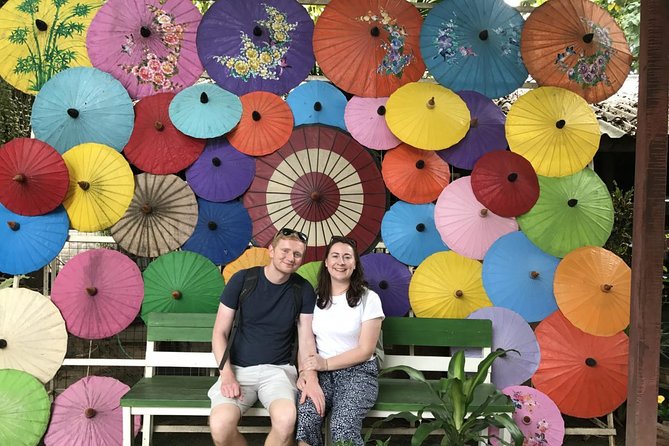
- San Kamphaeng + Bo Sang combo: two craft zones in one half-day.
- Free admission at the listed stops: your cost is mostly the tour, guidance, and transport.
- Door-to-door hotel transfers: smooth start and finish in central areas.
- You’ll have time for mementos: but shopping windows are short—bring your decision-making brain.
San Kamphaeng Road and Bo Sang in just half a day
This tour is built for people who want the craft story without spending your whole day getting lost between districts. You travel across Chiang Mai’s most famous handicraft corridors: the San Kamphaeng area (often called Chiang Mai’s craft highway) and Bo Sang, known for umbrellas.
What you’re really paying for is structure. In a single morning you get guided stops that connect the dots: raw materials and workshop steps, then finished products you can see up close. And because the group stays small, you’re not stuck listening from across the room. You can lean in, ask what’s happening, and get a sense for the craft workflow—why it takes time, and why the best pieces look the way they do.
You’ll also get a clear end point: after Bo Sang, you’re free to wander a bit for mementos, then you’re back at your hotel. That makes it a good choice when you want something meaningful but you still want your afternoon free for temples, food, or a long massage.
You can also read our reviews of more tours and experiences in Chiang Mai.



Pickup within Chiang Mai: easy start, small group focus
Your day starts at 8:00 am, and the tour includes an air-conditioned vehicle plus hotel pickup and drop-off for selected hotels. The best news for convenience is the tour offers free door-to-door pickup in the city center area within a 3 km radius (including spots like the Night Bazaar area, Tapae Gate, Chiang Mai Gate, Suan Dok Gate, Old City, Huay Kaew Road up to the Ibis Hotel area, and parts of the Nimmana/Nimmanhaeminda and Santitham areas).
If your hotel is farther out, there’s a 300 THB surcharge for pickup/drop-off outside the city center—listed as outside 5 km from the 3 King Monument. So, before you book, take a minute and check your location relative to that central marker. This is one of those small logistics things that can save you a small surprise later.
The other “quiet advantage” here is the group cap of 10 travelers. In craft settings, that matters. You’ll be able to keep moving, see what’s going on, and not fight for viewing space when a craftsperson demonstrates a step.
Silk weaving on San Kamphaeng Road: watching the process, not just products
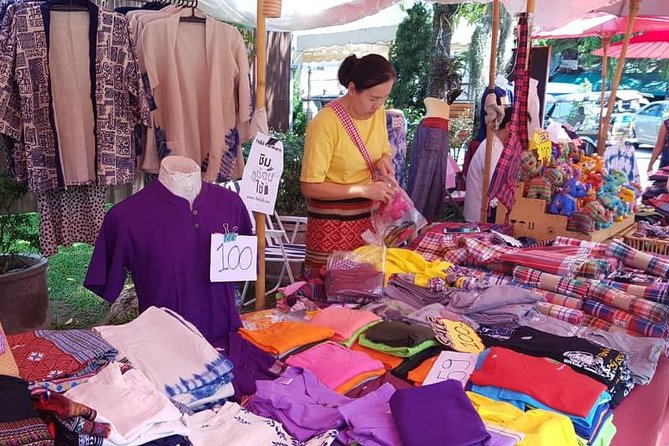
You start in the Sankampaeng area with a short ride-in feel (about 30 minutes), and then you get to the heart of the action: the San Kamphaeng Saturday walking street market stop (1 hour). The walking street vibe is useful even if you’re not shopping yet. It helps you understand the geography of the craft district—how workshops and factories sit close together, with demonstrations that show you the human side of production.
This is where you’ll watch locals demonstrate hand silk weaving, described as a generations-old method. Watching the process is the difference between looking at a finished scarf and understanding how long it takes to get there. Even if you don’t become a silk expert, you’ll start noticing why certain textiles look more precise or why patterns have a certain clarity.
You’ll also hear about the production process end-to-end. That matters for you as a buyer because you’ll be better able to ask sensible questions instead of relying on big promises. A good rule of thumb during craft demonstrations: ask what’s being made and what’s involved in that step. When you understand the step, the final product makes more sense.
One practical tip: wear comfortable walking shoes. The tour is short, but market-side routes can involve uneven pavement and lots of “step, stop, look” movement.
Baan Jang Nak: elephant wood carving museum and workshop center
After silk, the tour shifts into another craft world: Baan Jang Nak – A Museum of Elephant Wood Carvings. You’ll spend about 1 hour here.
Even if you’ve never seen elephant wood-style carving before, this stop helps because it’s not just display cases. You also go through a renowned wood and furniture factory area, where you can understand the processes that take items from raw materials to finished pieces. That factory context is what turns “wow, that’s detailed” into “now I see how that detail is made.”
You’ll also find an exhibit area that showcases locally made native items—costumes, jewelry, and home novelties. This is one of the places where you can pick up ideas for souvenirs beyond the usual tourist basics. And because the stop is guided, you’re not stuck trying to interpret every display on your own.
The one thing to keep in mind: carving is detail work, so it can feel slow if you’re expecting a high-energy market. But if you enjoy seeing how craftspeople convert materials into art, this stop is satisfying. It gives your brain something to latch onto before you move on to umbrellas.
Bo Sang umbrella village: Saa-paper parasols from scratch
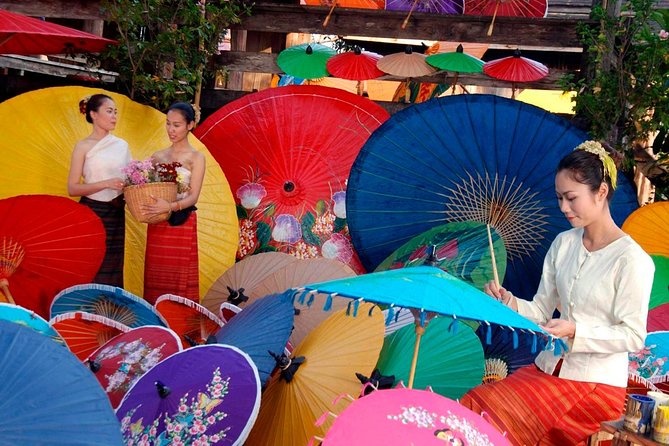
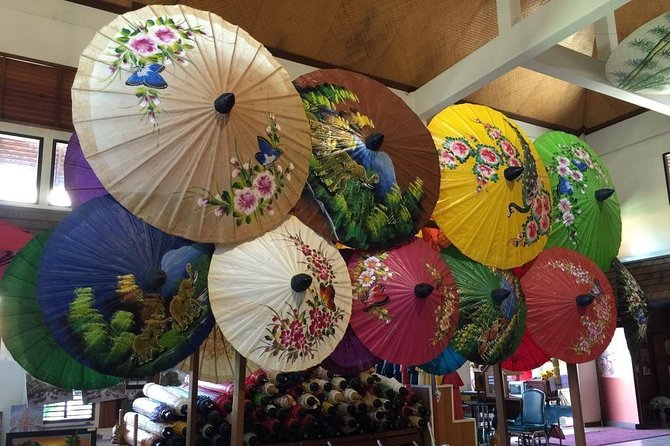
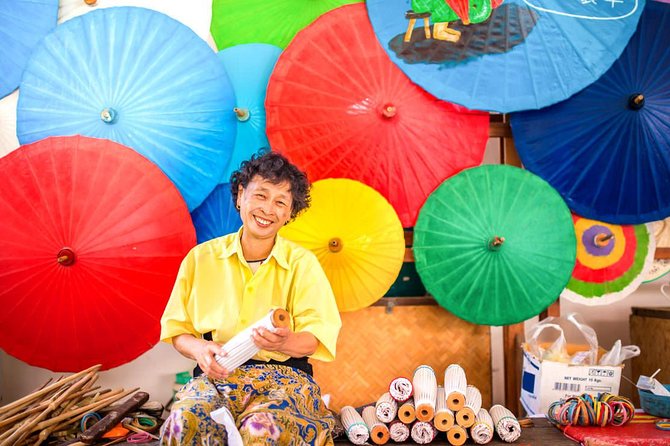
Then you hit the famous Umbrella Village in Bo Sang. You’ll see how Saa-paper umbrellas are made from scratch, and you’ll spend about 1 hour at this stage.
This part is especially fun because umbrellas are instantly recognizable. Once you see the construction steps, the craft stops being just a product and becomes a process you can imagine yourself taking home. It also helps you understand what you’re paying for when you buy: the work isn’t only about the outer look. It’s about the structure, the paper handling, the shaping, and the finishing steps that make the umbrella sturdy and visually clean.
After the umbrella-making viewing, you’ll have time to wander the district and interact with locals. That “hang time” at the end is important. It gives you a chance to look at mementos at your own pace instead of being rushed by the group schedule.
And yes, you’ll likely want something. The key is to use the earlier craft knowledge from silk and carving so you can shop with eyes open.



Price value and smart shopping in the craft zones
At $65 per person for about 4 hours, this tour isn’t the cheapest way to see crafts—but it’s also not trying to be. The value sits in three places:
- Guidance plus small-group pace (max 10)
You get help understanding what you’re seeing and how the steps connect.
- Transport with door-to-door convenience
For central Chiang Mai areas, pickup/drop-off is included with no charge within the stated radius. That saves time you’d otherwise spend coordinating.
- Workshop-style stops with free admission
Each listed stop is marked as free entry, so your money mostly covers the tour experience rather than entrance fees stacking up.
Shopping strategy for the time limit: pick one or two souvenir categories, not five. A common way to avoid regret is to decide in advance what you want most (for example, a textile piece from the silk area, or an umbrella from Bo Sang). Then, when you see options, focus on quality signals you already learned from the demonstrations.
If you’re price-checking, do it with questions, not just negotiation tactics. Ask what’s included in the materials and what makes one piece different from another. In one experience highlight from the craft side of the tour, our guide’s approach (Ms Ooh lala) made it easier to spot how different workshops connect—silk and wood work alongside other local crafts like celadon ceramics. That kind of context helps you buy with confidence instead of impulse.
Who this tour suits best (and who might want a different plan)
This tour is a great fit if you:
- want a half-day cultural activity with a clear schedule
- like watching making processes (weaving, carving, paper umbrella construction)
- prefer small groups where you can ask questions
- want practical souvenir shopping time without the hard sell
It may not be the best fit if you’re the kind of person who wants hours and hours to browse and compare on your own. The whole point of this experience is momentum and structure. You’ll leave with good craft knowledge and a few nice mementos, but you won’t get the slow, wander-all-day feel.
If you’re traveling with kids, the tour allows it as long as children are accompanied by an adult. And because it’s mostly walking with workshop viewing, you’ll want to stay comfortable on your feet for short bursts.
Should you book this Chiang Mai traditional handicraft tour?
Yes, I’d book it if you’re in Chiang Mai for a short stay or you want one craft-focused morning that doesn’t eat your entire day. It’s value-friendly because admission at the stops is free, you get air-conditioned transport, and the group stays small enough to actually engage with the process.
Skip it only if you’re chasing a long market day or you already have a plan to do crafts on your own with lots of free time. For most people, though, this is a smart “craft sampler” that leaves you informed and still gives you time to enjoy the rest of Chiang Mai.
FAQ
What is the duration of the Half Day Traditional Handicraft Craftsmanship Tour?
The tour lasts about 4 hours.
What time does the tour start?
The start time is 8:00 am.
How many people are in the group?
The tour has a maximum group size of 10 travelers.
Is hotel pickup included, and is it free in the city center?
Hotel pickup and drop-off are included for selected hotels. There is free door-to-door pickup within a 3 km radius of the city center area listed in the details. Outside that, a 300 THB surcharge may apply on the day.
Are admission tickets included for the stops?
All listed stops show Admission Ticket Free.
Is there a mobile ticket?
Yes, the tour includes a mobile ticket.
What should I wear?
Wear comfortable walking shoes, since you’ll be walking in market and village areas.
Is it okay to bring children?
Yes, children must be accompanied by an adult.
Can I cancel for a full refund?
The experience offers free cancellation. You can cancel up to 24 hours in advance for a full refund.